


Imagine this: A shopper browses your site, adds items to their cart, and… poof . They vanish. Sound familiar?
You’re not alone. Nearly 70% of online shoppers do this daily, leaving behind carts full of products they almost bought.
For retailers, this “almost” translates to staggering losses—millions slip through the cracks every year.
But here’s the good news: These abandoned carts aren’t failures. They’re golden opportunities.
Think of AI-powered product recommendations as your digital sales assistant. It quietly steps in when shoppers hesitate, nudging them with personalized suggestions right when they’re about to walk away . What if you could turn those “maybe later” moments into “I’ll take it!”?

This guide unpacks how smart tech and clever strategies—from timely discounts
to tailored follow-ups
—help you win back distracted buyers. We’ll show you how to transform casual browsers into loyal customers, one cart at a time.
Let’s begin by understanding why shoppers abandon their carts—and what this means for your business.
Key Takeaways
- Cart abandonment affects 70% of online shopping carts, costing retailers $260 billion annually.
- AI-powered recommendations intervene in real time to reduce abandonment and recover sales.
- Personalized suggestions increase conversion rates and customer engagement.
- Machine learning analyzes customer behavior to predict purchase intent.
- Intelligent engines tailor shopping experiences for each visitor.
- Predictive analytics identify at-risk customers before they leave.
Understanding Cart Abandonment and Its Impact on Your Business
Every abandoned shopping cart tells a story of lost revenue and missed opportunities.
When customers add products to their carts but leave without completing their purchase, your business faces a critical conversion challenge that demands immediate attention.
Online shopping cart abandonment rates average over 70%, representing a major challenge for ecommerce brands trying to convert visitors into buyers (Baymard Institute).
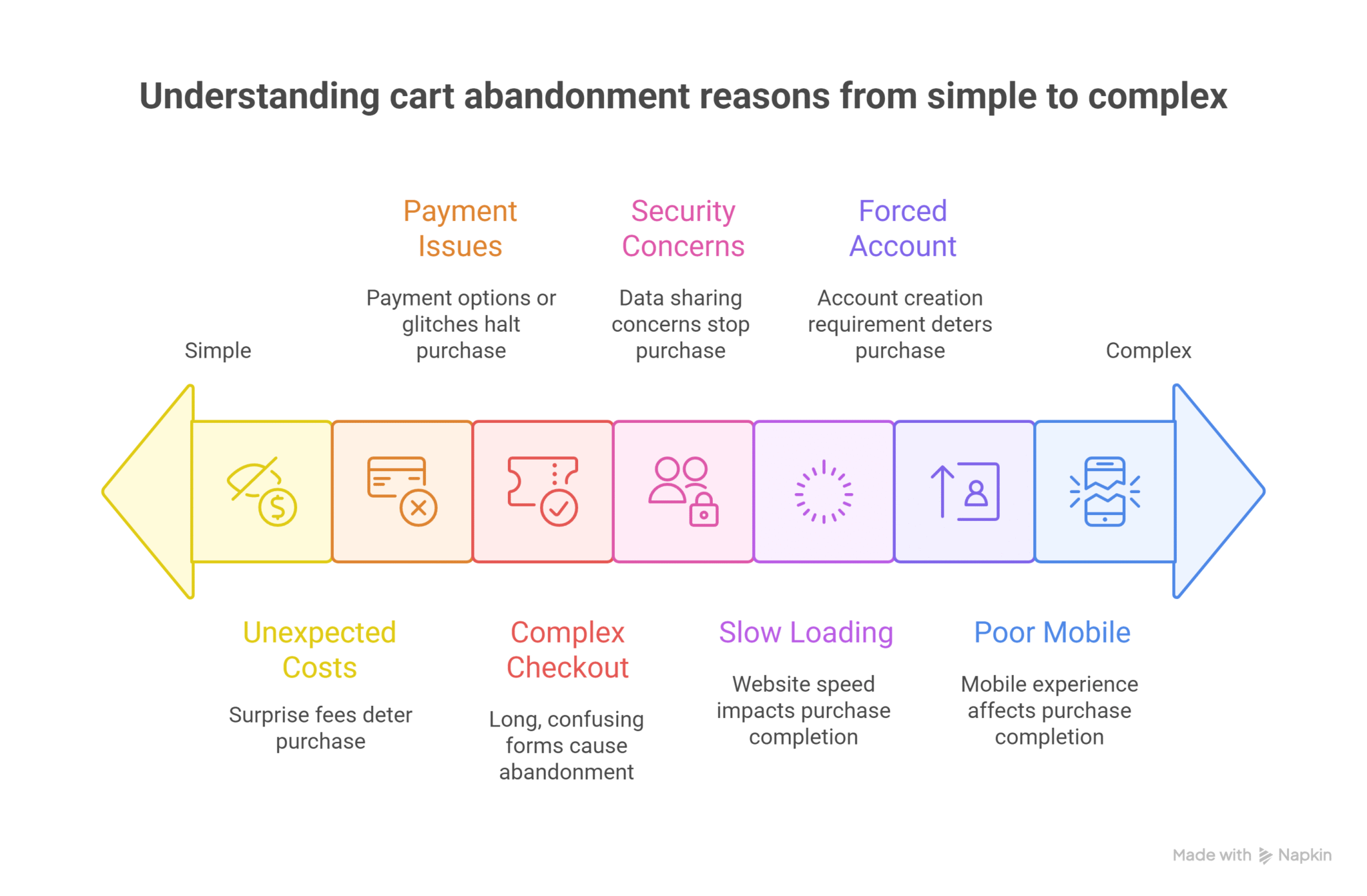
Why Do Shoppers Abandon Carts?
Industry data reveals the main reasons:
- Unexpected costs at checkout (48%): Surprise shipping fees or taxes cause nearly half of abandonments.
- Complex checkout processes (17%): Shoppers drop off when forms are long or confusing.
- Payment-related issues (13%): Lack of preferred payment options or technical glitches stop purchases.
Other common triggers include:
- Security concerns about sharing personal data
- Slow website loading times
- Forced account creation
- Poor mobile experience
Each abandoned cart represents a customer who showed real interest—browsing, comparing, and adding items. This is a purchase intent you can recover with the right approach.
The Financial Impact
- Cart abandonment costs retailers $260 billion annually.
- This figure represents revenue that could be recovered with effective strategies and a smoother checkout process.
How to Respond?
- Conversion rate optimization is essential. Here’s how you can start:
- Monitor carts in real-time to identify when shoppers are about to leave.
- Proactively offer support (like live chat or help pop-ups) at key friction points.
- Streamline checkout: Use transparent pricing, shorter forms, and multiple payment options.
- Leverage abandoned cart emails to re-engage potential buyers.
The Role of AI
Understanding your unique abandonment patterns allows you to implement targeted AI-powered solutions.
These systems address individual concerns and can dramatically improve your conversion rates through personalized interventions.
Now that we’ve explored the reasons behind cart abandonment, let’s see how AI-powered product recommendations can help win those customers back.
What Are AI-Powered Product Recommendations and How They Work
AI-powered product recommendations are changing how people shop online.
These systems use artificial intelligence to analyze each customer’s browsing history, past purchases, and preferences—right as they shop. By understanding what each shopper likes, AI can suggest products that are most relevant to them. This makes it easier for customers to find what they want and encourages them to complete their purchase.
How does it work?
- As soon as a customer visits your store, AI tracks what they click, how long they view products, and what they add to their cart.
- The system quickly compares this behavior with data from other shoppers.
- Based on these insights, the AI recommends items that fit the customer’s interests, increasing the chances of a sale.
Why is this important?
- Personalization: Shoppers see products matched to their unique tastes, so they’re more likely to buy.
- Proven results: 82% of business owners use AI to improve customer experience, and AI-driven marketing can bring 5–8 times the return on investment.
- Business growth: Using AI recommendations helps your store stand out, boost sales, and build customer loyalty.
But how do these AI-powered recommendations actually work? The answer lies in the machine learning algorithms that power them.
Machine Learning Algorithms Behind Smart Recommendations
AI-powered product recommendations are driven by machine learning algorithms that continually learn from customer interactions.
These algorithms can spot patterns and preferences that would be impossible for a human to notice, making your recommendations smarter and more effective over time.
There are three main types of algorithms used in ecommerce:
- Collaborative filtering: Suggests products based on what similar customers have purchased or liked.
- Content-based filtering: Recommends items that share features with products a customer has already shown interest in.
- Deep learning neural networks: Handle complex relationships and large datasets, enabling highly accurate and nuanced recommendations.
By analyzing every interaction—clicks, purchases, searches—these algorithms predict what each customer is most likely to want next.
This not only increases your average order value but also builds stronger customer loyalty.
Machine learning also helps your system quickly adapt to new shopping trends and changing customer preferences, ensuring your recommendations stay relevant as the market evolves.
To make these algorithms effective, AI must process data in real time and truly understand how your customers behave while shopping.
Real-Time Data Processing and Customer Behavior Analysis
Modern AI systems process customer data in real time, instantly responding to changes in shopping behavior.
This enables your store to display relevant products at the exact moment customers are most engaged, helping reduce bounce rates and increase conversion.
What does the AI track?
- Page dwell time and scrolling: How long a customer spends on a page and how far they scroll.
- Product views and comparisons: Which products a customer looks at and compares.
- Cart additions and removals: When items are added to or removed from the cart.
- Search queries and filter use: What customers search for and how they filter results.
- Device type: Whether they’re shopping on mobile or desktop.
AI systems analyze these behavioral signals to understand each customer’s intent. For example, if someone spends a long time viewing product details, the AI recognizes they’re close to making a purchase and can suggest related items or offer a timely incentive.
Advanced features include:
- Voice-powered product discovery: Customers can now search for products by speaking, and the AI matches their spoken requests to the most relevant items.
- Dynamic pricing and inventory-aware recommendations: The system can automatically promote products with higher profit margins or those you need to sell quickly, balancing your business goals with customer satisfaction.
By leveraging real-time data and smart analysis, your store can deliver a seamless, personalized shopping experience that stands out in a crowded ecommerce market.
Learn more about how Big Data and AI: A Practical Guide to Smarter Marketing Decisions can elevate your marketing strategy.
Next, let’s break down the main types of AI recommendation systems available for ecommerce businesses.
Types of AI Recommendation Systems for Ecommerce
Understanding the different types of AI recommendation systems is essential for selecting the best solution to reduce cart abandonment in your store.
Research shows that 67% of shoppers prefer product suggestions tailored to their interests, making the right recommendation engine a powerful tool for boosting sales and customer satisfaction.
There are three main types of AI recommendation systems in e commerce, each with its own approach to analyzing data and predicting what customers might buy:

Collaborative Filtering Recommendations
Collaborative filtering analyzes patterns across your customer base to find shoppers with similar preferences.
It recommends products based on what other customers with similar buying histories have purchased.
For example, if a customer buys running shoes, the system might suggest protein bars if other similar shoppers also bought them.
- Best for: Large product catalogs and diverse customer bases.
- Strength: Discovers hidden connections between products and increases cross-sell opportunities.
- Limitation: Struggles with new products that don’t have enough data (“cold start” problem).
Content-Based Filtering Systems
Content-based filtering focuses on the attributes of products and the preferences of individual customers.
It analyzes product features, categories, and descriptions to match items with what a customer has previously shown interest in.
If a shopper frequently buys organic skincare, the system will recommend other organic products.
- Best for: Stores with detailed product information and clear customer preferences.
- Strength: Can recommend new products immediately based on their attributes.
- Limitation: May create “filter bubbles,” where customers only see similar items and miss out on discovering new categories.
Hybrid Recommendation Approaches
Hybrid systems combine collaborative and content-based filtering to deliver more accurate recommendations.
They can switch between or blend both methods depending on the data available.
For example, if there’s enough user behavior data, the system uses collaborative filtering; for new products or users, it relies more on content-based filtering.
- Best for: Complex ecommerce environments with varied product types and customer segments.
- Strength: Combines the advantages of both approaches, adapting to different scenarios automatically.
- Limitation: Requires more technical setup and ongoing management.
| System Type | Best Use Case | Key Advantage | Main Limitation | Implementation Complexity |
|---|---|---|---|---|
| Collaborative Filtering | Large customer bases with diverse catalogs | Discovers unexpected product connections | Cold start problem for new items | Medium to High |
| Content-Based | Detailed product data and clear preferences | Works immediately with new products | May create recommendation bubbles | Low to Medium |
| Hybrid Systems | Complex ecommerce environments | Combines strengths of both approaches | Requires more technical implementation | High |
How to Choose?
Pick the system that matches your current business needs and available data. Many retailers start with one approach and move to hybrid systems as their data and technical capabilities grow.
Once you know which recommendation system best fits your business, it’s time to analyze your own cart abandonment patterns to target your strategy.
Step 1: Analyze Your Current Cart Abandonment Patterns
Starting to use AI for cart abandonment begins with understanding your customers. This step is key to making your AI strategy work.
Without knowing why customers leave, you can’t use ai-driven personalized product suggestions to prevent cart abandonment effectively.
Cart abandonment happens when people add items but don’t buy. About 49% do this because they’re just looking, and 14% because items are out of stock. Knowing why people leave is very important.

Looking at just the numbers isn’t enough. You need to see the whole journey to find where people get stuck. This helps you understand how AI can help in your business.
Identifying Key Abandonment Points in Your Checkout Process
First, map out your checkout process to find where people leave. Your data should show where customers drop off, like during product selection or payment. Each place needs a different fix.
Focus on these key reasons people leave:
- Unexpected shipping costs that show up too late
- Creating an account that’s too hard
- Forms that are too long or hard to use
- Not enough payment options
- Worries about security when paying
Mobile users often leave more than desktop users because of screen size and touch issues. Your analysis should look at these differences to find mobile-specific problems that ai product recommendation strategies to recover abandoned carts can solve.
Recent data shows that cart abandonment rates vary widely by industry and device, with mobile users exhibiting higher abandonment rates (Statista)
Gathering Customer Behavior Data and Shopping Patterns
Collecting lots of data helps you make detailed profiles for your AI strategy. Look at how people browse, what they search for, and how they use recommendations.
Break down your data into important groups:
- Customer type: New, returning, and loyal customers
- Product category: High-value, seasonal, and impulse buys
- Traffic source: Search, ads, social media, and email
- Geographic location: Where people are and shipping issues
This helps you see patterns and what customers need. Your goal is to make a detailed profile that helps pick the best ai-powered product recommendation tools for ecommerce for you.
Watch for small actions like scrolling, looking at images, and reading reviews. These small things show what customers want and where examples of ai-powered recommendations increasing checkout completion can help the most.
Step 2: Choose the Right AI Product Recommendation Engine
Choosing the right AI recommendation platform is key to your cart abandonment recovery success. The right engine turns browsing data into sales chances.
Retailers using AI agents to reduce cart abandonment typically see ROI within 3 to 6 months. They often see a 20–40% boost in cart recovery.
When picking a platform, balance technical skills with your business goals. It should handle data quickly and keep user experiences smooth. Smart evaluation saves time and prevents costly mistakes.
Evaluating Popular AI Recommendation Tools and Platforms
Top platforms offer big benefits for leveraging ai for personalized product recommendations and higher conversion rates. Amazon Personalize has top-notch machine learning and scalability. Shopify’s apps work well with existing stores.
Dynamic Yield is great for real-time AI product recommendations to reduce shopping cart abandonment. It processes consumer behavior fast. Salesforce Einstein gives deep analytics and recommendation tools.
Here are key things to look at:
- Recommendation accuracy – Test with your actual product catalog
- Processing speed – Ensure sub-second response times
- Customization options – Match your brand’s unique needs
- Analytics depth – Track the impact of ai-powered recommendations on ecommerce cart recovery rates
- Support quality – Get help when you need it
Smaller businesses might like Recombee or Yotpo. They offer strong features without being too complex. They’re great for testing recommendation success.
Integration Requirements and Technical Considerations
AI agents connect with e-commerce sites using APIs and webhooks. This lets them access cart and customer data in real-time. Your tech team should check how easy it is to integrate before choosing. Smooth data flow is key to avoid delays that upset customers.
Look at the API’s quality to see if the platform is mature. Good guides with examples are important. If it already works with popular ecommerce sites, it saves a lot of time.
Here’s what you need technically:
- Data security compliance – Follow GDPR and CCPA
- Scalability architecture – Handle big traffic without slowing down
- Mobile optimization – Make sure it looks good on phones
- A/B testing capabilities – Improve recommendation performance
- Email integration – Work with ai-powered product recommendations in cart recovery emails
Think about your team’s skills when picking a platform. Some need a lot of tech work. Others are easy to use for non-tech teams.
Don’t just look at the cost. Consider the time to set it up, keep it running, and any custom work needed. The right investment leads to better sales and less cart abandonment.
Your chosen platform should help with ai-based cross-sell and upsell recommendations for abandoned carts. This turns lost sales into gains. Test it with your real product data before deciding.
Once you’ve selected your platform, the final step is to implement your AI-powered recommendations and monitor their impact on cart recovery and sales.
Step 3: Implement Strategic Product Recommendations Throughout Your Site
To really benefit from AI recommendation engine benefits for reducing cart abandonment, you need to place them everywhere. Your site becomes a powerful tool for sales when you put smart suggestions in key spots.
Placing recommendations wisely turns casual shoppers into serious buyers. Each suggestion is a gentle push to keep customers moving toward buying.
IGK Hair changed their game with a personalized quiz. It helped shoppers pick their color, leading to a 30% increase in color sales and a 19% increase in average order value. Their story shows the power of smart placement.
Homepage and Category Page Recommendation Placement
Your homepage is where first impressions count. AI-driven dynamic product recommendations to boost cart recovery should welcome visitors with personalized picks based on their history and segment.
Put trending items front and center for new visitors. For returning customers, show items based on what they’ve bought before. This makes things personal and engaging.
Category pages need smart filters to help customers find what they need fast. AI-powered recommendation systems for ecommerce conversion optimization work best when they get customer intent and behavior.
Use smart sorting to show products customers like. Highlight “frequently bought together” items and products similar customers have bought. This makes shopping easier and faster.
Product Page Cross-Sell and Upsell Strategies
Product pages are your best chance to make a sale. Here, customers are already interested in something. Your ai-driven dynamic product recommendations to boost cart recovery should enhance their choice without overwhelming them.
Cross-sell suggestions should solve related problems or add to the main product’s value. Place them below the description where customers look for more info.
Upsell opportunities should offer premium versions or bundles with clear benefits. The difference between ai-powered product recommendations vs. generic recommendations for cart abandonment is clear here – AI knows about price and history.
Create sections like “Complete the Look” or “Customers Also Viewed” that feel helpful. Avoid pushing too hard, as it can scare customers away.
Shopping Cart Page Optimization Techniques
Your cart page is key to stopping abandonment. Optimizing checkout with ai-powered product suggestions needs a balance between helpful and salesy.
Offer “frequently bought together” suggestions that make sense with what’s in the cart. If someone buys a camera, suggest memory cards or cases. These should feel like natural additions.
Address doubts with smart suggestions. If items are out of stock, suggest similar ones. For low-value carts, offer items to hit free shipping.
Bundles are great on cart pages. Create dynamic bundles that offer real savings. This boosts average order value and gives customers value.
Consider adding urgency to your recommendations. Show limited-time offers or low-stock warnings. This motivates action without feeling forced.
Your strategy should change based on customer behavior. First-timers need different approaches than loyal customers. Cart abandoners need more push than confident buyers.
Keep testing different formats and positions. What works for one group might not for another. Your ai recommendation engine benefits for reducing cart abandonment grow when you optimize based on real data.
Learn how to refine your approach with A/B Testing with Data Science: Optimizing Your Marketing Campaigns.
Step 4: Deploy Exit-Intent and Real-Time Recommendations
Exit-intent technology and real-time cart monitoring are key to converting hesitant shoppers. They detect when customers are about to leave and offer personalized product suggestions. It’s important to use these tools in a way that feels helpful, not intrusive.
Modern AI agents analyze many data points to spot when customers might leave. They watch for signs like spending too long on checkout pages or switching tabs. This helps your system offer suggestions when customers are most likely to buy. To understand how to forecast such behaviors, see Predict Marketing Trends with Time Series Forecasting.
Real-time intervention within minutes of cart abandonment can catch customers when they’re most likely to buy. Studies show that immediate responses can increase conversion rates by up to 35%.
Setting Up Exit-Intent Popups with Smart Product Suggestions
Exit-intent popups are your last chance to keep customers from leaving. They detect when someone is about to leave and offer personalized help. Your popups should address specific concerns, not just offer discounts.
These pop ups use AI to suggest products based on what the customer has looked at. Predictive ai models for personalized product recommendations and abandoned cart recovery help find the best alternatives. This makes the suggestions more relevant and helpful.
Your exit-intent technology should offer different solutions based on customer behavior. For example, price-sensitive customers might get discounts, while those comparing products see detailed comparisons. Those worried about shipping costs might get free shipping offers.
The success of exit-intent popups depends on timing and relevance. Generic discounts work for 2-3%, but personalized suggestions can convert 8-12% of customers.
Set up your exit-intent system to show different messages based on cart value and customer type. High-value customers might get premium support or exclusive offers. First-time visitors see trust signals and product suggestions, while returning customers get personalized recommendations based on their history.
Real-Time Cart Monitoring and Intervention Strategies
Real-time cart monitoring tracks customer behavior throughout their shopping journey. It detects signs of hesitation, like spending too long on checkout pages. This triggers immediate help with targeted recommendations.
Use smart monitoring to track small interactions during checkout. Customers who click back a lot might see simplified checkout options. Those who leave forms unfinished get help or alternative payment methods. How to use ai chatbots with product recommendations to reduce cart abandonment is key when customers seem confused or frustrated.
Your real-time strategy should get more intense as customers show more signs of leaving. Initial hesitation might get subtle suggestions or trust signals. More hesitation could lead to chat support with personalized recommendations. Almost leaving might trigger exit-intent popups with strong offers.
For ecommerce teams wanting to build custom AI chatbots or recommendation assistants, Custom GPT offers an easy way to create tailored AI workflows without coding.
| Abandonment Signal | Intervention Type | Response Time | Conversion Rate |
|---|---|---|---|
| Extended checkout time | Simplified payment options | 30 seconds | 15-20% |
| Multiple cart modifications | Alternative product suggestions | 45 seconds | 12-18% |
| Tab switching behavior | Price comparison tools | 60 seconds | 10-15% |
| Form abandonment | Guest checkout options | 20 seconds | 25-30% |
Start with gentle suggestions and trust signals, then offer more help as needed. For those on the verge of leaving, offer significant discounts. This approach keeps the pressure off while encouraging customers to stay.
Make sure your real-time system works with customer service platforms for human help when needed. This is important for high-value customers or complex purchases. It combines AI’s efficiency with the personal touch of human support.
Ai-powered product recommendations for mobile shopping cart abandonment need special care for small screens. Mobile interventions should be less in-your-face and focus on clear, easy-to-use suggestions. Use swipe-friendly carousels and one-tap options to make it easy for mobile users.
Step 5: Create Personalized Email Follow-Up Campaigns
Personalized email follow-up campaigns are the last step in your cart abandonment recovery system. They offer ai-enabled product recommendations for higher average order value and lower abandonment. Your emails should feel like helpful shopping tips, not pushy sales.
Abandoned cart emails have a 45% open rate, making them a key tool for re-engaging customers. By combining high engagement with smart product suggestions, you can recover lost sales. Andie Swim saw a 55% increase in automated email flows revenue, thanks to their personalized quiz email sequences.
Your email strategy should segment customers based on their shopping habits. Price-sensitive customers need different messages than those who are unsure about products. This targeted approach ensures your recommendations meet specific customer needs.
Abandoned Cart Email Sequences with AI-Driven Recommendations
Your first abandoned cart email should focus on the items left behind. It should also include social proof and urgency. Send this email within one hour of abandonment to keep the shopping intent fresh. Add customer reviews, stock levels, and limited-time offers to encourage immediate action.
The second email should introduce alternative products based on browsing history. If someone left a red dress behind, suggest similar styles or accessories. This shows how algorithms find relevant alternatives.
Your third email can offer bundle deals and cross-sell opportunities. How does ai suggest products I might like? The system analyzes purchase patterns to suggest personalized bundles that increase average order value.
Dynamic content updates keep your emails current with pricing, availability, and recommendations. Real-time data processing ensures customers see accurate information based on their latest browsing and inventory levels.
Behavioral Trigger-Based Email Automation
Behavioral triggers start different email sequences based on customer actions and characteristics. Browse abandonment triggers send product recommendations when customers view items without adding them to cart. This approach captures interest before formal abandonment.
Your automation system should recognize returning customers and adjust messaging. First-time visitors need different treatment than loyal customers. Can artificial intelligence help me find products online? Yes, through sophisticated behavioral analysis that personalizes every customer interaction.
Price drop notifications are great for re-engaging price-sensitive customers. When items in abandoned carts go on sale, automated emails can bring customers back. This strategy works well for seasonal and clearance items.
Replenishment reminders are effective for consumable products and regular purchases. Your system should track purchase cycles and send timely reminders with easy reorder options. How do smart recommendations work in online shopping? They analyze historical data to predict when customers need product refills.
| Email Type | Send Timing | Primary Goal | Recommendation Focus |
|---|---|---|---|
| Initial Cart Recovery | 1 hour | Immediate conversion | Abandoned items + urgency |
| Alternative Products | 24 hours | Product discovery | Similar items + variations |
| Bundle Offers | 3 days | Increase order value | Complementary products |
| Final Reminder | 7 days | Last chance conversion | Discount + alternatives |
Your email automation should include win-back campaigns for customers who haven’t engaged with recent messages. These campaigns can feature personalized product collections based on past purchases and browsing behavior. The key is maintaining relevance while avoiding message fatigue.
A/B testing different subject lines, send times, and recommendation algorithms helps optimize your email performance. Test personalized subject lines against generic ones, and experiment with different product recommendation placements within your email templates.
Advanced AI Strategies: Predictive Analytics and Customer Segmentation
Predictive analytics and dynamic customer segmentation are the next steps in AI-powered product suggestions. These strategies create proactive shopping experiences. They anticipate customer needs before they leave.
Your business can use advanced AI models to analyze customer behavior. Why do I see personalized product suggestions when shopping online? It’s because these systems learn from every interaction.
Modern predictive models look at hundreds of data points at once. They track mouse movements and scroll patterns. They even look at typing speed in search boxes.
This detailed analysis shows what customers intend to buy before they make a decision.
Using Predictive Models to Anticipate Customer Needs
Predictive models turn customer data into insights about future behavior. Your AI system can spot customers likely to leave their carts. It does this by looking at specific behaviors that happen before they leave.
Extended page visits without action are early signs. When customers spend a lot of time looking at products without buying, your AI knows it’s time to act. How does machine learning recommend products to shoppers? It uses these cues to suggest products at the right time.
Your predictive models should track how customers use different devices. People might research on mobile but buy on desktop. Advanced AI keeps track of this to make sure recommendations are consistent.
Seasonal behavior prediction adds more complexity. Your system learns from past data to know when certain customers will want certain products. This helps with inventory management and marketing.
Dynamic Customer Segmentation for Targeted Recommendations
Dynamic customer segmentation goes beyond basic demographics. Your AI creates segments based on real-time behavior and preferences.
Are AI product recommendations accurate? Their accuracy comes from good segmentation. Your system groups customers by actual behavior, not just demographics. It identifies different shopping personalities, like bargain hunters and impulse buyers. For a deeper dive, check out our guide on Data Science for Customer Segmentation: A Step by Step Guide You Need for 2025 and Beyond.
Each segment needs different recommendations. Bargain hunters want detailed info, while impulse buyers like quick, appealing offers. Premium shoppers want exclusive, high-quality suggestions.
Your segmentation model should keep up with changing customer behaviors. What’s the benefit of using AI for product suggestions? AI adapts segments in real-time, keeping recommendations relevant as customers evolve.
| Customer Segment | Behavioral Indicators | Recommendation Strategy | Intervention Timing |
|---|---|---|---|
| Bargain Hunters | Price comparison, coupon searches, sale browsing | Discount alerts, bundle offers, price-drop notifications | Before competitor research |
| Premium Shoppers | Brand focus, quality reviews, luxury browsing | Exclusive products, premium features, expert recommendations | During consideration phase |
| Impulse Buyers | Quick decisions, social media influence, trending items | Limited-time offers, social proof, visual appeals | Immediate engagement |
| Research-Heavy | Multiple sessions, detailed comparisons, review reading | Detailed specs, comparison tools, expert guides | After research completion |
Advanced segmentation looks at predictive lifetime value. How does AI know what products to recommend? Your system focuses on building long-term relationships, not just immediate sales.
Cross-device behavior mapping keeps segments consistent. When customers switch devices, your AI keeps their segment and recommendation history. This creates seamless shopping experiences that reduce abandonment rates.
Optimizing AI Product Recommendations for Mobile Shopping
Your mobile strategy is key to whether AI helps or hinders your sales. Today, over 60% of shoppers use mobile devices. They often leave carts behind, but the right AI can change that.
Mobile shoppers browse quickly, often while doing other things. They make fast decisions based on what they see first. Can AI improve my online shopping experience? Yes, but only if it’s made for mobile.
Your mobile system needs to work with touch screens and smaller screens. Unlike desktop users, mobile shoppers want quick, easy-to-find suggestions. These should load fast and be easy to see.
Mobile-Specific Recommendation Placement and Design
AI recommendations on mobile need to be easy to find and use. They should fit with how people naturally move their thumbs. This makes shopping easier and less likely to cause mistakes.
Good places for AI suggestions include just below product images and sticky bars. How do ecommerce sites use AI for product recommendations? Top sites use them to help, not distract from, the main product info.
Designing for mobile means making things big enough to tap easily. But they should also show important info without being too much.
| Mobile Placement | Conversion Impact | User Experience Score | Implementation Difficulty |
|---|---|---|---|
| Below Product Images | High (23% increase) | Excellent | Easy |
| Sticky Bottom Bar | Medium (15% increase) | Good | Medium |
| In-Cart Suggestions | Very High (31% increase) | Excellent | Easy |
| Exit-Intent Overlays | High (28% increase) | Fair | Hard |
Your mobile interface should be fast and simple. Use lazy loading and progressive enhancement for better performance. What technology powers personalized product recommendations? Machine learning that’s fast and efficient is best.
Try swipeable carousels for a natural feel. They make browsing easy and fun. Make sure to show where you are and how many more items there are.
Voice-Powered Product Discovery Integration
Voice commerce is the next big thing in mobile shopping. It lets customers find products by talking to their devices. This is a big change from typing.
Your voice system should handle complex questions. Instead of typing “red running shoes size 9,” say “I need comfortable running shoes for my morning jogs, preferably in red.” How does AI personalization work in ecommerce? It uses natural language to understand what you want.
Voice commerce will fundamentally change how customers discover products, making AI recommendations more conversational and intuitive than ever before.
Make sure your voice search works well with your AI system. It should understand what you mean and give you answers right away.
Voice shopping is great for people who can’t use screens much. They can shop while doing other things, like driving or cooking.
Your voice system should let users reorder, compare products, and get audio descriptions. Is AI good at predicting what I want to buy? Yes, with voice data, AI gets to know you better.
Use progressive web app features for offline voice commands. This way, your recommendations work everywhere, even without the internet.
The future of mobile AI is all about knowing where you are and what you need. Your system should adapt to your location and time of day. This way, it gives you the best suggestions for your situation.
Measuring Success: Key Metrics and Analytics for Your Recommendation System
To measure your recommendation system’s success, you need a detailed analytics framework. It should track specific performance indicators that show how AI product recommendations affect your profits. The data collected will help make improvements and prove the system’s value to stakeholders.
Retailers using AI to reduce cart abandonment often see a return on investment in 3 to 6 months. They report a 20-40% boost in cart recovery rates. This success comes from focusing on the right metrics and acting on insights quickly.
Tracking key performance indicators such as abandonment rate reduction and recommendation-driven sales is critical for optimizing ecommerce performance (Shopify)
Cart Abandonment Rate Tracking and Analysis
Your main metric should be the cart abandonment rate before and after AI recommendations. Track this metric for different customer groups, product types, and time frames. Compare rates for users who see recommendations and those who don’t.
Watch how abandonment changes at different checkout stages. Your analytics should show where customers drop off and how recommendations affect them. Track the percentage of recovered carts thanks to AI suggestions.
For a deeper dive into using analytics and algorithms to drive ecommerce growth, check out SEO Data Science: How to Leverage Algorithms & Analytics for Sustainable Growth.
Break down abandonment data by device, traffic source, and customer demographics. This detailed analysis helps understand why online stores recommend certain products to specific users. For example, mobile users might behave differently than desktop users, needing tailored strategies.
Conversion Rate and Revenue Impact Measurement
Your conversion rate metrics should track both direct and indirect impacts of recommendations. Look at how many visitors convert after seeing suggested products. Also, compare the average order value for users who see recommendations versus those who don’t.
Understanding revenue attribution is key to seeing how recommendations work. Measure the percentage of total revenue from recommended products. Track cross-sell and upsell success to see how AI boosts sales beyond the first purchase.
Calculate the lifetime value of customers who engage with recommendations. These users often stick around longer and buy more. Your analytics should show the long-term financial gains from personalized suggestions.
| Metric Category | Key Performance Indicator | Target Improvement | Measurement Frequency |
|---|---|---|---|
| Cart Recovery | Abandonment Rate Reduction | 20-40% decrease | Weekly |
| Revenue Impact | Recommendation-Driven Sales | 15-25% of total revenue | Monthly |
| User Engagement | Recommendation Click-Through Rate | 8-12% CTR | Daily |
| Conversion Optimization | Add-to-Cart Rate from Suggestions | 25-35% improvement | Weekly |
Customer Engagement and Retention Metrics
Customer engagement metrics show how recommendations impact user experience. Track time on site, pages per session, and return visits for users who see AI suggestions. These metrics help understand if recommendations enhance or disrupt the shopping journey.
Monitor recommendation click-through rates in different locations. For example, homepage suggestions might differ from product page ones. Knowing these patterns helps optimize placement and improve user engagement.
Retention metrics are key for long-term success. Track how often customers return after personalized recommendations. Measure the impact on customer lifetime value and repeat purchases. This data shows how AI analyzes shopping behavior to build lasting customer relationships.
Use cohort analysis to see how recommendations work over time. Compare customer behavior with different strategies. Your analytics should reveal which approaches lead to the strongest engagement and retention.
A/B testing lets you compare different recommendation algorithms and placements. Test various approaches to understand what’s the difference between
AI product recommendations and manual suggestions in performance. Use these insights to continually improve your system for better results.
Common Implementation Challenges and Proven Solutions
Starting to use smart product suggestions can be tough. Ecommerce sites often face similar problems when using ai-powered recommendations in ecommerce. Knowing these challenges helps you find good solutions.
Modern recommendation systems can be complex. You’ll need to tackle both technical and trust issues. Each problem needs a solution that fits your business and what your customers want.
Data Privacy and Customer Trust Considerations
Protecting customer data is key. Today’s shoppers want to know how recommendation engines use customer data. You must balance making things personal with keeping data safe.
Rules like GDPR and CCPA affect how you collect data. You need to get clear consent from customers. They should know what data you use and how it makes shopping better for them.
Being open about data use builds trust. Give customers easy ways to control their data. Make sure they can opt out without losing out on good deals.
Keep customer data safe by using encryption and secure APIs. Regular security checks help find and fix problems before they happen.
Being upfront about data protection is important. Explain how machine learning in ecommerce personalization works without risking privacy. Your customers should feel safe and get useful product suggestions.
Technical Integration Hurdles and Workarounds
Getting data from different systems is hard. Your engine needs to access inventory, behavior, and purchase history fast. Different data formats can mess up recommendations.
You need strong infrastructure to handle lots of traffic. Your system must respond quickly to keep users happy. Slow responses can hurt sales.
Integrating with other systems can be tricky. Old platforms might not work well with new tools. You might need to do custom work to make them work together.
Tools like N8n io simplify workflow automation by connecting your ecommerce platform with AI recommendation engines and other marketing tools seamlessly.
API management can help with integration. Cloud-based platforms are flexible and can grow with your business. They handle more traffic than old systems.
Having a good backup plan is important. Make sure your system works even when things go wrong. Test these plans regularly.
Start small when introducing new features. Begin with simple suggestions and add more later. This way, you can find and fix problems before they upset customers.
Keep an eye on how well your system works. Your team should watch performance and user feedback. Update your system often to keep it running well.
Plan for growth to avoid technical problems later. Choose solutions that can handle more data and users. Your system should keep working well as your business grows.
Test your system thoroughly before launching. Check how smart product suggestions work on shopping websites in different situations. Include tests for mobile, different browsers, and busy times.
Case Studies: Successful AI Product Recommendations in Action
Big names and small businesses alike show how AI can change the game. They use ai-powered recommendations to get results that old methods can’t. Companies of all sizes are growing fast thanks to smart use of recommendation engines.
Success stories come from all walks of business. Each tale highlights key elements for success. These include deep customer data analysis, constant algorithm tweaks, and strategic placement in the customer journey.
Amazon’s Recommendation Engine Success Story
Amazon’s system makes 35% of their total revenue from personalized product suggestions. Their success comes from analyzing customer behavior in real-time. They process millions of data points to offer relevant suggestions.
Amazon blends collaborative filtering with content-based algorithms. This mix looks at what customers buy together and their browsing habits. Their product recommendations pop up everywhere, from the homepage to checkout upsells.
Their success comes from using many data sources. They look at purchase history, browsing, and similar preferences. This approach makes their recommendations feel spot-on for each shopper.
Netflix’s Personalization Strategy Impact
Netflix keeps users hooked and cuts down on leaving. Their system checks viewing history, time spent watching, and ratings to suggest content. This has changed the streaming game.
Netflix mixes ai-powered recommendations with human touch for the best results. Their algorithm considers similar viewers and individual tastes. This ensures recommendations are both accurate and varied.
Netflix’s success shows personalized recommendations can go beyond online shopping. Their system adapts to user habits in real-time. This keeps customers engaged longer than traditional ways of finding content.
Small Business Ecommerce Transformations
Small businesses are seeing big wins with AI. BedGear saw a 490% increase in conversions with a quiz-based system. This shows how targeted suggestions can boost customer interest.
IGK Hair saw a 30% increase in color sales and 19% higher average order value with AI. Their success shows how beauty brands can use data to suggest products. They analyze skin tone, hair type, and style to make smart suggestions.
Stitch Fix combines AI with human stylists for 20% better customer retention than traditional retail. Their hybrid approach shows how mixing AI with human touch can beat automated systems. Personal stylists and AI work together to match individual tastes.
Whisker saw a 388% increase in conversion rates in just 30 days with a quiz system. This fast success shows how quickly AI can transform a business. It proves small companies can compete with big ones with the right tech.
Small business success stories share common traits. They focus on adding value, not just making sales. They collect quality data and keep improving their algorithms. This ensures they keep growing.
The best product recommendations mix different approaches. Personalized suggestions work best for loyal customers. Related product suggestions are great for new visitors. Cross-sell and upsell at checkout can boost order values without being pushy.
Conclusion
Your ecommerce success depends on turning abandoned carts into sales. With 70.19% of carts left behind and $260 billion lost each year, the chance for growth is huge. Now, you have a complete guide to use AI for product recommendations, cutting cart abandonment rates.
The choice between content-based, collaborative, and hybrid algorithms depends on how they use customer data. Your plan should focus on where to show product recommendations on your site. From the homepage to product pages and cart optimization, these spots are key to boosting sales and conversions.
Success stories like BedGear’s 490% boost and Amazon’s 35% revenue from recommendations show the value of personalization. You can tailor product suggestions for each customer using their browsing history, purchase patterns, and current actions.
Being ahead of the game is your edge. The retail world favors those who use AI for personalization, making shopping better. By using these strategies, you’ll turn abandoned carts into sales and build stronger customer ties, leading to lasting profits.
FAQ
What are AI-powered product recommendations and how do they work?
AI-powered product recommendations use smart systems to analyze your data. This includes what you’ve looked at, bought, and how you behave. They learn from you over time, getting better at suggesting products that fit your taste.
These systems handle a lot of data quickly. They make suggestions that feel like they know you, creating a personalized shopping experience.
How do AI product recommendations help reduce cart abandonment?
AI helps by addressing your concerns right when you need it. If something’s out of stock, it suggests alternatives. It also offers deals to make shipping worth it and items that add value.It watches for when you might leave and offers something to keep you. This makes shopping more enjoyable and keeps you from leaving without buying.
What types of AI recommendation systems are most effective for ecommerce?
There are three main types: collaborative filtering, content-based filtering, and hybrid. Hybrid systems are the most effective. They combine both methods for better accuracy.
Where should I place AI-powered recommendations on my website?
Place them on your homepage, category pages, product pages, and shopping cart page. Make sure they feel natural and helpful. They should change based on how you behave and what you’ve done before.
How can I measure the effectiveness of my AI recommendation system?
Look at how it reduces cart abandonment and boosts sales. Check click-through and add-to-cart rates. Also, see how long people stay on your site and if they come back.Try different strategies with A/B testing. Use cohort analysis to see how it affects customer value over time.
What data is needed to generate effective product recommendations?
You need browsing history, what you’ve bought, demographics, and real-time behavior. It also looks at how long you stay on pages and what you click on.
How do I choose the right AI product recommendation engine for my business?
Look for one that fits with your current setup and can handle your traffic. Make sure it’s secure, follows GDPR, and works well on mobile. Check its analytics and API access too.
Can AI recommendations work for small businesses or just large retailers?
AI works for any size business. Small businesses like BedGear and IGK Hair saw big boosts in sales. The key is finding a platform that fits your budget and provides real value to customers.
How do AI recommendations work on mobile devices?
Mobile AI is designed for smaller screens and touch. It uses swipeable carousels and voice discovery. It also considers your location and time of day for better suggestions.
What are the privacy concerns with AI product recommendations?
Privacy worries include how data is collected and used. Make sure you’re clear about this. Follow GDPR and CCPA rules. Give customers control over their data.
How quickly can I see results from implementing AI recommendations?
You’ll see improvements in a few weeks. At first, you’ll see more people engaging with your site. Over time, you’ll see more sales. Most see a big drop in cart abandonment in 30-60 days.
What's the difference between AI recommendations and traditional "customers also bought" suggestions?
Traditional suggestions are based on simple patterns. AI uses complex algorithms to understand you better. It learns and adapts, making suggestions that fit your unique behavior.
How do predictive analytics enhance AI product recommendations?
Predictive analytics look at your behavior to spot when you might leave. They forecast how valuable you’ll be as a customer. This lets them make recommendations before you abandon your cart.
Can AI recommendations integrate with email marketing campaigns?
Yes, AI can create personalized emails for abandoned carts. It uses your browsing history and similar purchases. It also segments customers based on why they left, making emails more relevant.
What are the common implementation challenges with AI recommendation systems?
Challenges include data privacy, technical integration, and customer trust. Use secure APIs, be transparent, and test thoroughly. Roll out slowly and monitor continuously.