


You are new-age or Gen Z Marketer, Just imagine you get to know what will be trending in future and you have a client of $100,000 or any high ticket client
You’re predicting an insta meme that will go viral. Yes it is possible via Time Series Analysis
I’m excited to share how time series analysis can predict seasonal marketing trends. Did you know it’s used in business, finance, and supply chain management?
It helps understand sales and distribution patterns, making it key for smart decisions.
Time series analysis looks at data to find patterns and trends. This is important for forecasting and making informed choices. It’s a powerful tool for businesses to plan ahead.
As we dive into time series analysis, we’ll see how it helps businesses. It’s all about using data to predict and take advantage of seasonal trends. With more data available, time series analysis is more important than ever.
Understanding Time Series Forecasting Fundamentals
Time series forecasting helps predict future values by looking at past data. It’s key to know the parts of time series data like trend, seasonality, and irregularity.
Forecasting with time series means finding patterns to make good predictions. This helps businesses plan better and stay ahead.
Working with time series data means understanding forecasting in time series. It’s about looking at past data, finding seasonal patterns, and picking the right model. Techniques like AR, MA, and ARIMA are often used.
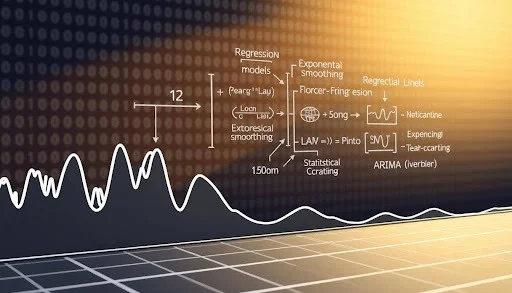
Let’s dive into the basics of time series forecasting. Here are the main parts of time series data:
- Trend: The long-term direction of the data
- Seasonality: Regular patterns that occur at fixed intervals
- Cyclic variations: Patterns that occur over a longer period
- Irregularity: Unpredictable changes in the data
Knowing these parts and using time series forecasting helps businesses make smart plans. This leads to better decision-making and strategy.
Essential Tools and Technologies for Marketing Predictions
For marketing predictions, the right tools and technologies are key. Time series analysis models and time series models are vital for accurate forecasts.
But, what are time series, and what does time series analysis entail? Simply put, time series are data points at regular intervals. Time series analysis is about studying and predicting these points.
Marketers can start with tools like Facebook’s Prophet, made for “Forecasting at Scale.” It adjusts to trend changes and handles seasonal data well. Google’s TensorFlow and cloud services like Big Query and Vertex AI also boost time-series abilities.
Key benefits of time series analysis models include:
- Improved accuracy in predictions
- Ability to handle large datasets
- Automatic adjustment to trend changes
- Handling data with pronounced seasonality

Understanding time series and analysis helps marketers choose the best tools. With the right tools, marketers can fully use time series models. This leads to accurate predictions that help grow the business.
Preparing Your Marketing Data for Analysis
To make a strong model time series, you need to get your marketing data ready for analysis. This means cleaning the data, dealing with missing values, and making seasonal variables consistent. This ensures your data is right, complete, and steady, which is key for time series modeling.
For time series forecasting python, having good data is critical. Studies say you need at least 12-16 weeks of marketing data to spot trends and changes. With top-notch data, you can build a forecasting model that helps you make smart choices.
Here are some tips for getting your marketing data ready:
- Data preprocessing: clean and handle missing values and outliers
- Model selection: pick the best model for your data
- Parameter tuning: tweak model parameters for better results
By following these tips and using the right tools, like python libraries for time series forecasting, you can create a strong model. This model will help grow your business and enhance your marketing plans.
Implementing Time Series Analysis Models
In today’s fast-paced business world, staying ahead of marketing trends isn’t just helpful—it’s essential. Imagine being able to predict what your customers will want next or how market shifts might impact your strategy.
That’s where time series analysis comes into play. By mastering a few key models, businesses can unlock patterns in their data, forecast trends with confidence, and make smarter decisions that drive growth. Let’s break down three game-changing tools every marketer should know: ARIMA, Prophet, and neural networks.
Why These Models Matter
Think of these tools as your crystal ball for marketing. They don’t just analyze past data—they anticipate future trends. Whether you’re planning a holiday campaign or adjusting budgets mid-year, predictive modeling gives you the edge to act strategically, not reactively.
1️⃣ ARIMA: The Time-Tested Workhorse
(Autoregressive Integrated Moving Average)
ARIMA is like the Swiss Army knife of forecasting. It’s been around for decades, and for good reason. By blending autoregression (learning from past values), differencing (smoothing out trends), and moving averages (accounting for random fluctuations), it’s perfect for stable, recurring patterns.
Use Case: Predicting quarterly sales for a retail chain.
Why It Works: Handles seasonality and trends in data that’s already “cleaned up.”
2️⃣ Prophet: The User-Friendly Innovator
Developed by Meta, Prophet is the new kid on the block designed for real-world chaos. It thrives on messy data—think missing values, sudden spikes (like a viral campaign), or holidays messing with your metrics.
Use Case: Forecasting daily website traffic during Black Friday sales.
Why It Works: Simple to use, even if you’re not a stats whiz. It automatically detects shifts and explains them in plain language.
3️⃣ Neural Networks: The Pattern-Spotting Powerhouse
For complex, nonlinear trends (like social media virality or influencer-driven demand), neural networks shine. These AI-driven models learn hidden patterns in massive datasets, adapting as new data flows in.
Use Case: Predicting viral TikTok trends impacting product demand.
Why It Works: Handles noise and complexity better than traditional models.
Putting It All Together
Imagine you’re a coffee chain planning next year’s marketing. ARIMA could forecast monthly sales based on historical data. Prophet might adjust for a new store opening or a competitor’s promo. Neural networks could predict how a TikTok trend around pumpkin spice lattes might go viral.
The Bottom Line?
These models aren’t just math—they’re strategic tools. By blending ARIMA’s reliability, Prophet’s adaptability, and neural networks’ brainpower, businesses don’t just guess the future; they shape it.
Ready to turn your data into decisions? 📈 Let these models guide your next move.
Leveraging Python for Time Series Forecasting
Python is a top choice for time series forecasting. Libraries like Prophet and statsmodels make it easy to build and check models. This helps marketers create strong models for better decision-making.
Python is great for data analysis and statistical modeling. Libraries like pandas and NumPy help process data quickly. This speeds up model creation and use.
Using Python for time series forecasting has many benefits. Here are a few:
- Easy-to-use libraries and frameworks
- Fast and efficient data processing
- Robust and reliable model development
Python also excels in machine learning. It can make time series forecasts more accurate. By mixing traditional stats with machine learning, forecasts get better.
Python is a strong tool for time series forecasting. It offers many libraries for building reliable models. By using Python, marketers can understand their data better and make smarter choices.
Translating Analysis into Marketing Strategy
Fellow marketers! Let’s talk about something we all live for—transforming cold, hard data into campaigns that actually work.
You know that feeling when you crack the code on timing? Like, imagine launching a product right when everyone’s itching to spend (hello, holiday shopping frenzy!). That’s the power of blending trend analysis with gut instinct.
Here’s the thing: timing isn’t just a detail—it’s everything. Picture this. You’re reviewing last year’s sales data and suddenly—bam—you spot a pattern: sales spike every Black Friday, then nosedive in January.
Why not shift your budget to ride that wave instead of fighting the off-season slump?
And let’s get real about predictive modeling. It’s like having a crystal ball. Take companies that drop new products in Q4—they’re not just guessing. They’re using past sales data to predict that festive-season dopamine rush we all get. Retailers? They’re not just “adjusting budgets”; they’re playing 4D chess with holiday trends.
Some important things to think about when turning analysis into a marketing plan include:
- Identifying peak marketing periods and allocating budget wisely
- Timing campaigns to match seasonal trends
- Using predictive modeling to forecast sales and adjust marketing plans
By combining marketing trends and predictive modeling, businesses can make smart choices and grow. Presenting forecasts well can include using visuals, scenario analysis, and clear communication. As a marketer, it’s vital to keep up with the latest trends and predictions to create a winning strategy.
Common Pitfalls and How to Avoid Them
Working with time series forecasting can be tricky. Overfitting and underfitting are two big problems. Overfitting means a model is too detailed and picks up on random data points. Underfitting is when a model is too simple and misses important patterns.
To steer clear of these issues, it’s key to check your data and model carefully. Use cross-validation and regularization to stop overfitting. For underfitting, try making your model more complex or use more advanced methods. Also, don’t overlook seasonal patterns in your data. They’re important for accurate forecasts.
Some common mistakes include:
- Ignoring non-stationarities in the data, such as trends or seasonality
- Using inappropriate models for the type of time series data
- Failing to evaluate the model’s performance using metrics such as mean absolute error or mean squared error
By knowing these pitfalls and how to avoid them, marketers can make better forecasts. This is done by combining different forecasting methods, machine learning, and data analysis. This way, you can spot and handle seasonal changes and other data quirks.
Conclusion: Making Time Series Analysis Work for Your Marketing Goals
Mastering time series analysis is key for marketers wanting to predict marketing trends. It helps make smart decisions. By understanding seasonal patterns, trends, and irregularities, marketers can use advanced analytics to boost their campaigns.
Insights from time series analysis reveal the best times to market and how to spend your budget. You can use ARIMA models, the Prophet framework, or neural networks. The goal is to find the best methods for your marketing data.
Using time series analysis for your marketing goals lets you predict changes in consumer behavior. It helps you take advantage of seasonal trends and stay ahead of competitors. With the right tools and strategies, your brand can succeed in a changing world. You can create personalized, data-driven campaigns that connect with your audience.
FAQ
What is time series analysis and why is it important for predicting seasonal marketing trends?
Time series analysis is a way to study data over time. It helps find patterns and trends in data. This is key for making smart decisions in business.
With more data available, it’s become essential for business. It helps companies spot and use seasonal marketing trends.
What are the key components of time series data, and how do they relate to marketing forecasting?
Time series data has three main parts: trend, seasonality, and irregularity. Knowing these is vital for making good forecasts.
What are the different types of time series models, and how can they be applied to marketing predictions?
There are AR, MA, and ARIMA models for time series data. These help predict marketing trends. They help companies spot and use seasonal trends.
What are the essential tools and technologies used for marketing predictions, and how do they compare in terms of capabilities and limitations?
Tools like Prophet are popular for forecasting. They make it easy to build and check models. Knowing their strengths and weaknesses helps choose the right tool.
What are the best practices for preparing marketing data for time series analysis, and why is data quality important?
To prepare data, clean it, handle missing values, and normalize seasonal variables. Good data quality is key for reliable models.
What are the different approaches to implementing time series analysis models, and how can they be applied to real-world marketing problems?
There are ARIMA, Prophet, and neural network models. Each has its own benefits and drawbacks. Knowing these helps create effective models for marketing.
How can Python be leveraged for time series forecasting, and what are the key libraries and tools available?
Python has tools like Prophet and statsmodels for forecasting. It helps create strong models for marketing insights.
How can time series analysis be translated into effective marketing strategy, and what are the key considerations?
Use analysis to find peak times, plan budgets, and time campaigns. This way, marketers can make the most of trends and grow their business.
What are the common pitfalls in time series forecasting, and how can they be avoided?
Pitfalls include overfitting, underfitting, and ignoring patterns. Strong models can avoid these issues. This ensures accurate predictions for marketing trends.