


The Power of Python in Digital Marketing
Python is changing digital marketing in big ways. With Python you have a superpower with you, that helps you access the whole digital marketing space with the most unexpected and interesting perspective, it is easy to learn and execute, it helps you build your own automations for the boring marketing tasks that you ought to automate
Why Marketers Are Turning to Python
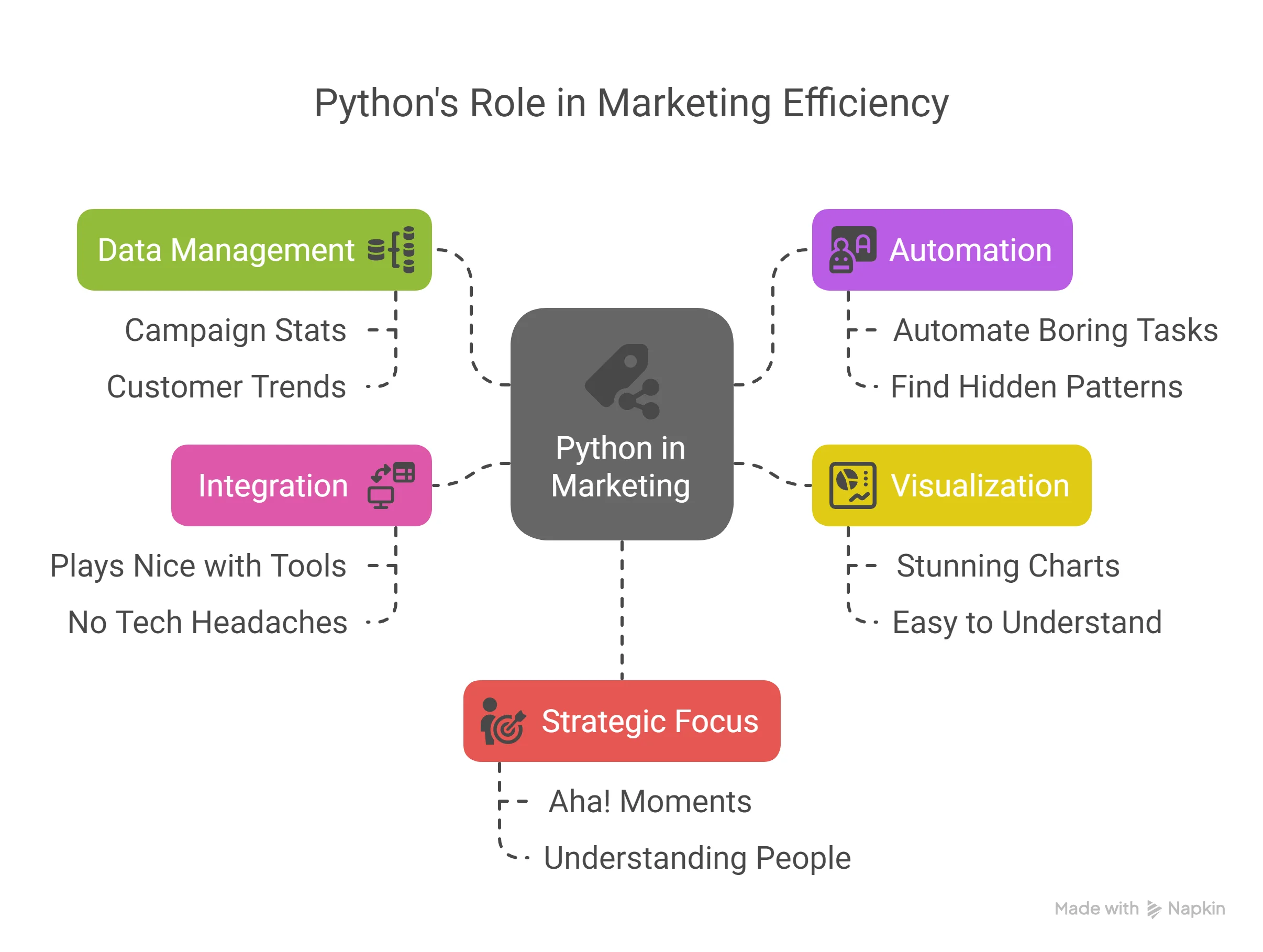
Ever wonder why marketers are flocking to Python like it’s the last slice of pizza at a team meeting? Here’s the secret sauce: it actually gets how busy marketers think.
Instead of wrestling with complicated code, you’re working with something that feels like texting a colleague – straightforward and (dare we say) kinda fun.
Picture this: You’ve got campaign stats pouring in from six different platforms. Python doesn’t just help you wrangle that data – it becomes your personal assistant. Automate the boring stuff? Check. Find hidden patterns while your coffee’s still warm? Absolutely. Create stunning charts that even your spreadsheet-phobic boss can understand? You bet.
And here’s the kicker – it plays nice with all the tools you’re already using. No more “square peg, round hole” tech headaches. Whether you’re digging into customer trends or proving campaign ROI, Python’s like having a Swiss Army knife for data.
But here’s what really clicks for marketers: It leaves you brain space for the big stuff. Less time debugging code means more time for those “aha!” moments that actually move the needle. After all, shouldn’t we spend our energy understanding people, not just programming machines?
Essential Python Libraries for Marketing Analytics
Key libraries for marketing analytics include Pandas and NumPy for handling data. Matplotlib and Seaborn are great for making data visualizations. These tools help you understand and use marketing data well.
Scikit-learn is another important library. It has advanced machine learning tools for predictive models. This boosts your marketing analytics work.
Here are 9 More Python Libraries You can try
Data Collection and Analysis with Python
Python is great for collecting and analyzing data to boost your marketing. It has many libraries and is easy to use. This makes it perfect for marketers who want to get insights from different data sources.
Web Scraping for Market Research
Python is famous for its web scraping skills. It lets you pull important data from websites. With tools like BeautifulSoup and Scrapy, you can get market data, check on competitors, and see what customers like.
This info is key for knowing the market and making smart choices.
Automated Data Collection from Multiple Sources
Python is also top-notch at automating data collection. You can write scripts to get data from places like social media, customer databases, and market reports. This saves time and makes sure your data is right and current.

Data Visualization for Marketing Insights
After getting data, you need to analyze and show it. Python has libraries like Matplotlib and Seaborn for data visualization. These tools help you make charts that are both interactive and clear. This makes it easy to spot patterns and trends in your data.
Building Custom Marketing Dashboards
You can also make custom marketing dashboards with Python. Tools like Dash let you build dashboards that show important metrics like KPIs and campaign results. This way, you can keep an eye on your marketing in real-time and make choices based on data.
Using Python for data work can really improve your marketing. Whether it’s web scraping, automating data, or making dashboards, Python has what you need to move your marketing forward.
- Enhance market research with web scraping
- Automate data collection from multiple sources
- Visualize data for better insights
- Create custom dashboards for real-time monitoring
SEO and Content Marketing Applications
Ever felt like you’re spinning your wheels with SEO and content marketing? What if I told you there’s a friendly tool that works like a caffeine boost for your marketing strategy?
Meet Python – the unexpected sidekick modern marketers are using to cut through the digital noise. While it might sound like something for coders in hoodies, here’s the truth: it’s becoming the ultimate wingman for anyone trying to actually make their content work smarter, not harder.
Here’s why your marketing team might be missing out:
SEO Magic Made Simple
Instead of drowning in spreadsheets, imagine automating keyword research while you sip your morning coffee. Python helps spot patterns even Sherlock would miss.
Content That Actually Connects
It’s like having a crystal ball for your audience – analyze what sticks, tweak what flops, and keep your content calendar feeling fresh instead of frantic.
From “Meh” to “Must-Click”
Automate the boring stuff (goodbye, manual reporting!) so you can focus on the creative magic that got you into marketing in the first place.
Here’s the kicker: You don’t need to become a coding wizard. Basic Python skills can help you:
✓ Spot trending topics before they peak
✓ Turn data into “aha!” insights during meetings
✓ Make your boss wonder how you became an SEO oracle
The real tea? Brands using these tricks are seeing 3x more organic traffic. It’s not about replacing human creativity – it’s about giving your brain the space to do its best work.
Ready to stop chasing algorithms and start leading them? Python might just be your ticket from overwhelmed to “Oh, I’ve totally got this.” 🚀

Keyword Research and Analysis
Doing keyword research and analysis is key for a good SEO plan. Python’s tools like NLTK and spaCy help find keyword trends and relevant terms. This optimizes content for better search rankings.
Content Performance Analysis
Understanding content performance is critical. Python helps analyze page views, engagement rates, and conversion rates. This gives insights to improve content marketing strategies.
Social Media Data Extraction and Analysis
Python is also useful for social media data extraction and analysis. It gathers insights from social media platforms. This helps understand audience preferences, track brand mentions, and measure campaign success.
Using Python in SEO and content marketing leads to better decisions. It optimizes marketing strategies and boosts traffic and engagement to your content.
Customer Insights and Personalization
Python helps unlock deep customer insights for personalization. This is key in today’s market. Knowing your customers well is essential for good marketing strategies.
Python has tools and libraries for customer insights. One big use is in sentiment analysis of customer feedback. By looking at customer reviews and social media, businesses can see how customers feel about them.
Sentiment Analysis of Customer Feedback
Sentiment analysis uses NLP to find the emotional tone in feedback. Python libraries like NLTK and TextBlob make it easy. You can sort feedback as positive, negative, or neutral to find what needs work.
Customer Segmentation for Targeted Campaigns
Customer segmentation is vital with Python in marketing. It lets you target specific groups with campaigns. Python’s data tools help segment customers well, making marketing more effective.

Predicting Customer Lifetime Value (CLTV)
Predicting Customer Lifetime Value (CLTV) shows a customer’s long-term worth. Python’s machine learning lets you build models for this. This helps focus on customers who are most valuable.
Lead Scoring and Qualification
Lead scoring scores are based on their readiness to buy. Python helps create detailed scoring models. This way, you can spot and focus on the best leads.
In summary, Python’s role in customer insights and personalization is huge. It helps in making targeted campaigns, improving customer engagement, and growing the business. By using sentiment analysis, segmentation, CLTV prediction, and lead scoring, businesses can stand out in the market.
Python for Marketing Automation and Optimization
Python lets you do more than just analyze data. It helps you automate and optimize your marketing for better results. With its wide range of libraries and tools, you can make your marketing work smarter and faster.
Python is great for many marketing tasks. It helps with A/B testing, ad analysis, marketing attribution, and sales forecasting. Let’s explore how Python can change your marketing game.
A/B Testing and Optimization
A/B testing is key to finding the best marketing strategies. Python makes this easier by automating tests and analyzing results. With Scikit-learn and Scipy, you can make smart choices to improve your campaigns.
Ad Performance Analysis
Checking how ads perform on different platforms can be tough. But Python makes it easier. It uses APIs to get ad data and Pandas for handling it. This way, you can see how ads are doing and make them better.
Marketing Attribution Modeling
Knowing how your marketing efforts impact your business is vital. Python’s data tools help you create models that show each channel’s role. This helps you use your budget wisely.
Sales Forecasting with Machine Learning
Sales Forecasting is important for planning. Python’s machine learning tools, like TensorFlow and PyTorch, help you predict sales. This lets you make smart decisions and stay competitive.
Using Python for marketing automation and optimization can greatly improve your marketing. It helps you get better results and a higher return on investment.
Competitive Intelligence and Advanced Applications
Python is a key tool in digital marketing, helping you stay ahead of rivals with data. It’s great for improving competitive intelligence, making marketing better, and growing your business.
Competitor Analysis and Monitoring is vital. Python lets you watch what competitors do online, study their marketing, and find market gaps. With tools like BeautifulSoup and Scrapy, you can grab data from their sites and social media. This gives you a clear view of their strengths and weaknesses.
Competitor Analysis and Monitoring
Python makes it easy to keep an eye on competitors. You can track their marketing moves and see how customers react. This helps you tweak your plans, use your rivals’ weaknesses, and lead the pack.
Dynamic Pricing Strategies
Python helps with dynamic pricing strategies too. It looks at market trends, customer habits, and what others charge. With tools like Pandas and NumPy, you can set prices that change with the market to boost profits and market share.
Integration of Marketing Tools
Python is also top-notch for integrating marketing tools. It uses APIs and libraries like Requests and PyQuery to link different marketing tools. This makes your work smoother and keeps data consistent across all channels.
Fraud Detection in Advertising
Python is key in fraud detection in advertising too. It uses machine learning to spot and stop fake ad traffic. This saves your ad budget and makes sure your ads reach the right people.
By using Python for competitive intelligence and advanced marketing, you can get ahead of your rivals. You’ll make your marketing better and help your business grow.
Conclusion: Transforming Your Marketing with Python
Python can change how you market. It helps you understand data, automate tasks, and make your campaigns better.
Using Python for marketing can grow your business. It improves how you connect with customers and keeps you competitive. You can also predict trends and make smart choices based on data.
Python has many tools for marketing tasks. It’s great for collecting and analyzing data, doing SEO audits, and segmenting customers. By using Python, you can change your marketing and reach your goals.
Explore Python for marketing now. See how it can help you succeed in the digital world.
FAQ
What are the benefits of using Python in digital marketing?
Python helps a lot in digital marketing. It automates tasks, analyzes big data, and makes predictions. This makes it great for marketers to understand data and improve their work.
How can Python be used for data collection and analysis in marketing?
Python is great for web scraping and collecting data. It also helps in making dashboards and visualizing data. Libraries like Pandas and Matplotlib make it easy to work with data.
What are some applications of Python in SEO and content marketing?
Python is useful for SEO audits and keyword research. It also helps in analyzing content and social media data. This makes it easier for marketers to improve their strategies.
How can Python help in gaining customer insights and personalization?
Python helps in understanding customer feedback and segmenting them. It also predicts customer value and scores leads. This way, marketers can create campaigns that really connect with their audience.
What are some ways Python is applied to marketing automation and optimization?
Python is used for A/B testing and analyzing ad performance. It also helps in modeling marketing attribution and forecasting sales. This makes it easier for marketers to make smart decisions.
Can Python be used for competitor analysis and monitoring?
Yes, Python is great for analyzing competitors and monitoring the market. It also supports dynamic pricing and fraud detection in ads. This keeps marketers ahead of the game.
What are some essential Python libraries used for marketing analytics?
For marketing analytics, you need Pandas and NumPy for data work. Matplotlib and Seaborn are key for visualizing data. These libraries help marketers dive deep into their data.
How can I get started with using Python for marketing?
To start with Python for marketing, check out DataCamp and freeCodeCamp. There are also many online tutorials. Use Python libraries and tools made for marketing to get the most out of it.